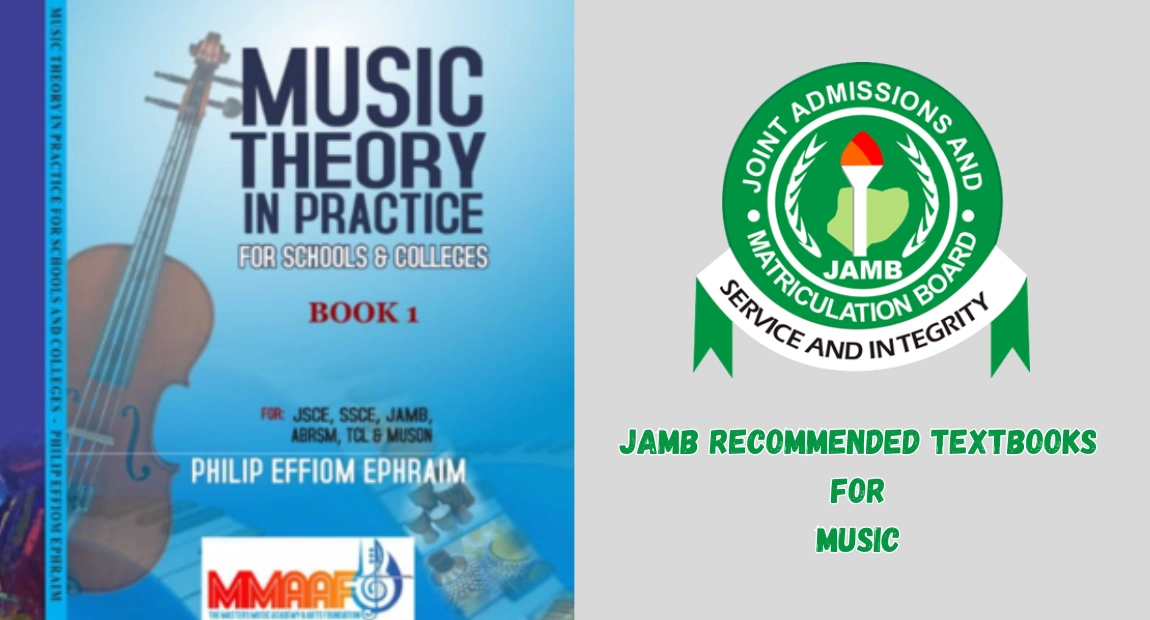
Preparing for JAMB Music requires a good balance of theory, listening knowledge, and understanding of both Western and African musical traditions. Many candidates struggle not because the subject is too hard, but because they do not use the right materials that fully cover the JAMB Music syllabus. That is why studying with the JAMB recommended textbooks for Music 2026/2027 is very important for serious UTME candidates.
The recommended Music textbooks for JAMB are designed to help students understand musical elements, notation, harmony, form, instruments, African music, and music history. These areas are regularly tested in UTME Music, so using approved books gives you a strong academic advantage and helps you avoid missing key topics.
In this guide, you will find the official list of JAMB recommended textbooks for Music 2026/2027, a study strategy for using them effectively, and answers to common questions about preparing for JAMB UTME Music.
Recommended Textbooks for JAMB UTME Music 2026/2027
Below is the approved list of JAMB recommended textbooks for Music for the 2026/2027 UTME examination. These books collectively cover theory, appreciation, African music, harmony, and performance knowledge.
| S/N | BOOK TITLE | AUTHOR (Year) | DESCRIPTION |
|---|---|---|---|
| 1 | Foundation of Nigerian Traditional Music | Kpabot, S. E. (1986) | Explains Nigerian traditional music forms, rhythms, and cultural contexts. |
| 2 | Rudiments and Theory of Music | Associated Board of the Royal School of Music (1958) | Covers basic music notation, scales, intervals, and time signatures. |
| 3 | The Form of Music | Cole, W. (1969) | Explains musical structures such as binary, ternary, rondo, and sonata form. |
| 4 | Nigerian Musical Instruments | Echezona, W. W. C. (1981) | Detailed guide to African instruments and their classifications. |
| 5 | Choir Training and Choral Conducting for Africans | Ekwueme, L. (1993) | Focuses on vocal training, rehearsal techniques, and African choral styles. |
| 6 | An ABC of Music | Holst, I. (1963) | Introduces basic musical concepts in simple language for beginners. |
| 7 | Instruments of the Orchestra | Hosier (1961) | Explains orchestral instrument families and their functions. |
| 8 | Elements of Music | Hunt, R. (1960) | Covers rhythm, melody, harmony, texture, and tone color. |
| 9 | Music for Secondary Schools Vols. I and II | Inanga, A. (1993) | Structured for secondary students with theory and listening activities. |
| 10 | Music: An Appreciation | Kamien, R. (1990) | Introduces music history and listening skills across musical periods. |
| 11 | The Concise Oxford Dictionary of Music (3rd Ed.) | Kennedy, M. (1985) | Reference book for musical terms, composers, and styles. |
| 12 | Elementary Harmony Book 2 | Kitson, C. H. (1978) | Explains chord progressions and basic harmonic writing. |
| 13 | Hausa Performing Arts and Music | Kofoworola, Z. O. & Lateef, Y. (1987) | Focuses on Northern Nigerian music and performance traditions. |
| 14 | A Concise History of Music | Lovelock, W. (1953) | Summarizes Western music history from early to modern periods. |
| 15 | The Rudiments of Music | Lovelock, W. (1996) | Covers basic theory including notation and rhythm patterns. |
| 16 | The Enjoyment of Music | Machlis, J. (1977) | Builds appreciation and understanding of different music styles. |
| 17 | Folksongs for Schools | Mensah, A. A. (Undated) | Collection of African folk songs suitable for learning and practice. |
| 18 | The Oxford Harmony Vol. I | Morris, R. O. (1974) | Advanced explanation of harmony and chord relationships. |
| 19 | African Music | Nketia, J. H. (1974) | In-depth study of African musical systems and performance practices. |
| 20 | Teach Yourself Music | Palmer, K. (1965) | Self-study guide covering theory and basic performance knowledge. |
| 21 | Basic Music: A Basic Theory Text | Reed, H. O. (1954) | Step-by-step approach to understanding music theory. |
| 22 | The Guide to Music Theory | Taylor, E. (1989) | Comprehensive theory reference for exam preparation. |
| 23 | Graded Music Course for Schools, Books I–III | Warburton, A. O. (1955) | Progressive lessons for school-based music learning. |
Recommended Posts:
- Recommended Textbooks for all JAMB Subjects 2026/2027
- JAMB Recommended Textbooks for Use of English 2026/2027
- JAMB Recommended Textbooks for Chemistry 2026/2027
- JAMB Recommended Textbooks for Principle of Accounts 2026/2027
How to Study Music for JAMB Using These Textbooks
To prepare effectively for JAMB UTME Music, start by following the JAMB Music syllabus topic by topic instead of reading randomly. Choose one main theory textbook such as Rudiments and Theory of Music or The Guide to Music Theory and combine it with at least one African music textbook like African Music or Foundation of Nigerian Traditional Music.
Divide your study into sections: theory, history, African music, instruments, and harmony. For theory, practice writing notes, intervals, and time signatures. For music history and appreciation, focus on identifying musical periods, composers, and styles. When studying instruments, learn both orchestral and African instrument classifications and their sound qualities.
After reading each topic, revise with short notes and answer past JAMB Music questions related to that topic. This helps you understand how JAMB frames theory and listening-based questions. Regular revision, practice of objective questions, and strong understanding of musical terms will greatly improve your performance in JAMB Music.
Frequently Asked Questions (FAQs)
Ques: Are these the official JAMB recommended textbooks for Music 2026/2027?
Ans: Yes, these books are part of the approved textbooks that cover the full JAMB Music syllabus and are suitable for UTME preparation.
Ques: Do I need to read all the books listed to pass JAMB Music?
Ans: No, you only need a few strong textbooks that cover theory, African music, and music appreciation, then use others for reference when needed.
Ques: Is JAMB Music more theoretical or practical?
Ans: JAMB Music is mainly theoretical and objective-based, focusing on music theory, history, instruments, and African music knowledge.
Ques: Which topics are most important for JAMB Music?
Ans: Important topics include rudiments of music, harmony, musical forms, African music, orchestral instruments, and music history.
Ques: Can I study JAMB Music without a music teacher?
Ans: Yes, with good textbooks and consistent practice, many students prepare successfully on their own.
Ques: Do I need to know how to play an instrument to pass JAMB Music?
Ans: No, playing an instrument is not required, but understanding how instruments produce sound is important.
Ques: How can I memorize musical terms easily?
Ans: Create flashcards or short notes and revise them daily to improve retention of musical definitions.
Ques: Is African music heavily tested in JAMB Music?
Ans: Yes, African music is an important part of the syllabus, especially traditional instruments and performance practices.
Ques: How often should I practice JAMB Music questions?
Ans: You should practice objective questions regularly, especially after completing each topic.
Ques: Can I score high in JAMB if Music is one of my subjects?
Ans: Yes, with proper study of recommended textbooks and consistent revision, many students score very well in JAMB Music.