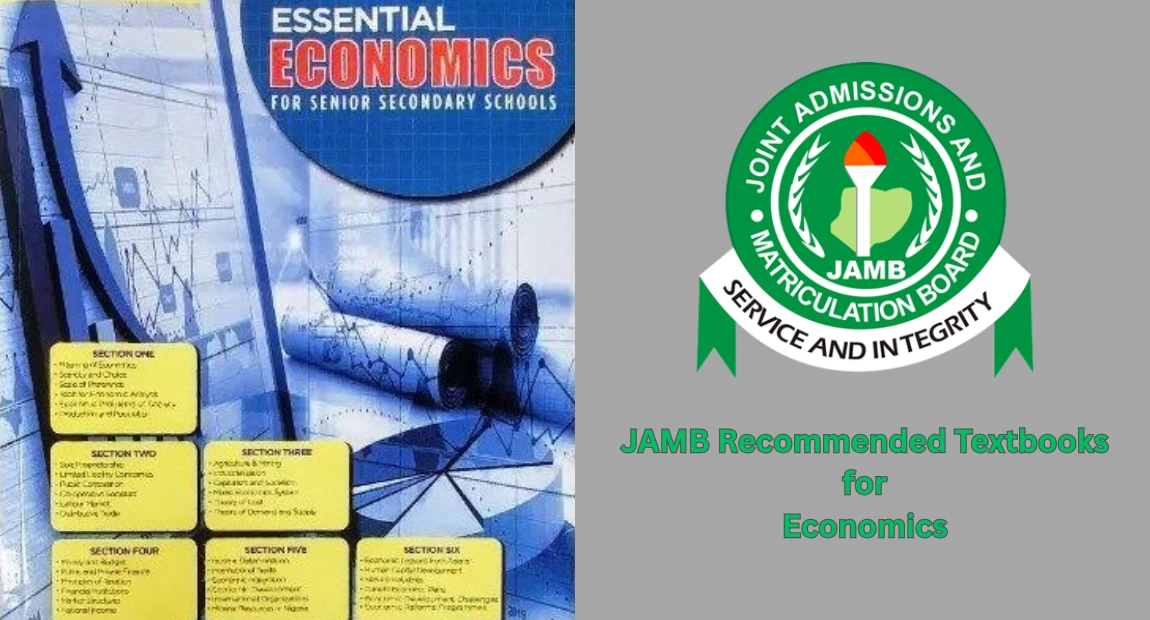
Economics is one of the most analytical subjects in JAMB, where its main concepts concerning scarcity, demand and supply, price theory, production, national income, money and banking, public finance, population, international trade, inflation, unemployment, and economic development can easily be understood using JAMB recommended textbooks for Economics.
JAMB recommends the best Economics textbooks for UTME, with the common ones being; Senior Secondary Economics textbooks, Economics study guide for JAMB, Microeconomics and macroeconomics books for Nigerian students, and we have provided these books here for you to help you prepare for the examination.
Recommended Textbooks for JAMB UTME Economics 2026/2027
| S/N | BOOK TITLE | AUTHOR | DESCRIPTION |
|---|---|---|---|
| 1 | Economics: Exam Focus | Aderinto, A.A. et al. (1996) | A popular revision textbook offering concise summaries of major topics, model exam questions, and topic-by-topic explanations tailored for WASSCE, NECO, and JAMB. |
| 2 | Oxford Dictionary of Economics | Black, J. (1997) | A comprehensive reference dictionary that explains thousands of economic terms and definitions. Useful for clarifying difficult concepts, theories, and terminology. |
| 3 | Economics Made Easy | Eyiyere, D. O. (1980) | A student-friendly introductory text that breaks down difficult topics using simple language. Suitable for beginners and for clarifying foundational concepts. |
| 4 | Countdown to SSCE/JME Economics | Fajana, F. et al. (1999) | A revision-focused text covering all key areas of Economics with practice questions and sample solutions. Helps students reinforce knowledge before the exam. |
| 5 | Round-Up Economics | Falodun A. B. et al. (1997) | A summary-style Economics textbook widely used for last-minute preparation. Contains solved exercises, definitions, and quick explanations that make revision easy. |
| 6 | Modern Microeconomics | Koutsoyiannis, A. (1979) | A classic university-level text offering in-depth coverage of microeconomic theory; demand, supply, elasticity, production, cost curves, price determination, and market structures. |
| 7 | An Introduction to Positive Economics | Lipsey, R. G. (1997) | A respected Economics text that explains both micro and macro principles, national income, fiscal policy, money and banking, trade, and development. Helps students understand the logic behind economic analysis. |
| 8 | Economics | Samuelson, P. & Nordhaus, W. (1989) | One of the world’s most famous Economics textbooks. Covers foundational and advanced topics in both microeconomics and macroeconomics. Recommended for students aiming for deeper conceptual understanding. |
| 9 | New System Economics: A Senior Secondary Course | Udu E. & Agu G. A. (2005) | A Nigerian senior secondary school Economics course aligned with WAEC, NECO, and JAMB syllables. Covers demand and supply, production, population, money, banking, government policies, and development economics. |
| 10 | Economics | Wannacott & Wannacott (1979) | Provides strong explanations of both micro and macroeconomic theory. Helps students understand price theory, income determination, consumption, and international economics. |
| 11 | What is Micro-Economics? | Brownson-oton Richard (2010) | A concise text introducing microeconomic concepts in simple terms. Helpful for beginners or those struggling with theory. |
These books are also WAEC/NECO/JAMB Economics preparation materials, Economics syllabus textbooks for UTME, as well as an Introduction to Economics for secondary school students being included.
Recommended Post:
- Recommended Textbooks for all JAMB Subjects 2026/2027
- JAMB Recommended Textbooks for Computer Studies 2026/2027
- JAMB Recommended Textbooks for Geography 2026/2027
- JAMB Recommended Textbooks for Government 2026/2027
How to Study Economics for JAMB Using These Textbooks
1. Understand basic concepts before solving questions: Economics builds on definitions and principles. Master scarcity, choice, opportunity cost, demand, supply, and elasticity first.
2. Use diagrams and graphs frequently: Price curves, cost curves, supply-demand graphs, and production possibility curves appear in JAMB questions.
3. Study microeconomics and macroeconomics separately: Break the subject into sections for easier retention.
4. Practise solving UTME-style objective questions: Questions often repeat themes, especially in inflation, national income, population, money and banking, price theory, and international trade
5. Use revision books before the exam: Exam Focus and Round-Up Economics help consolidate learning quickly.
6. Review past questions regularly: This reinforces familiar patterns and improves exam confidence.
Frequently Asked Questions (FAQs)
Ques: Which is the best textbook for beginners?
Ans: Economics Made Easy by Eyiyere is simple and foundational.
Ques: Which textbook is best for complete JAMB preparation?
Ans: New System Economics (Udu & Agu) and Exam Focus Economics are the most aligned with JAMB.
Ques: Do I need university-level texts like Samuelson or Lipsey?
Ans: Not required, but they offer deeper insight for students who want advanced understanding.
Ques: Is microeconomics more important for JAMB?
Ans: Both micro and macro topics appear frequently. Questions are usually balanced.
Ques: How important are graphs in Economics?
Ans: Very important. Many questions are based on interpreting or analysing graphs.
Ques: Can I rely solely on revision books like Exam Focus?
Ans: Revision books help, but pairing them with a full textbook like Udu & Agu is best.
Ques: Do I need to study international trade?
Ans: Yes. Topics like balance of payments, tariffs, and foreign trade show up often.
Ques: Are past questions useful?
Ans: Extremely. JAMB repeats question patterns in Economics more than many other subjects.
Ques: How many hours weekly should I study Economics?
Ans: Three to four focused study sessions per week are ideal.
Ques: Are these books useful for WAEC and NECO too?
Ans: Yes. All recommended textbooks align with SSCE-level requirements.