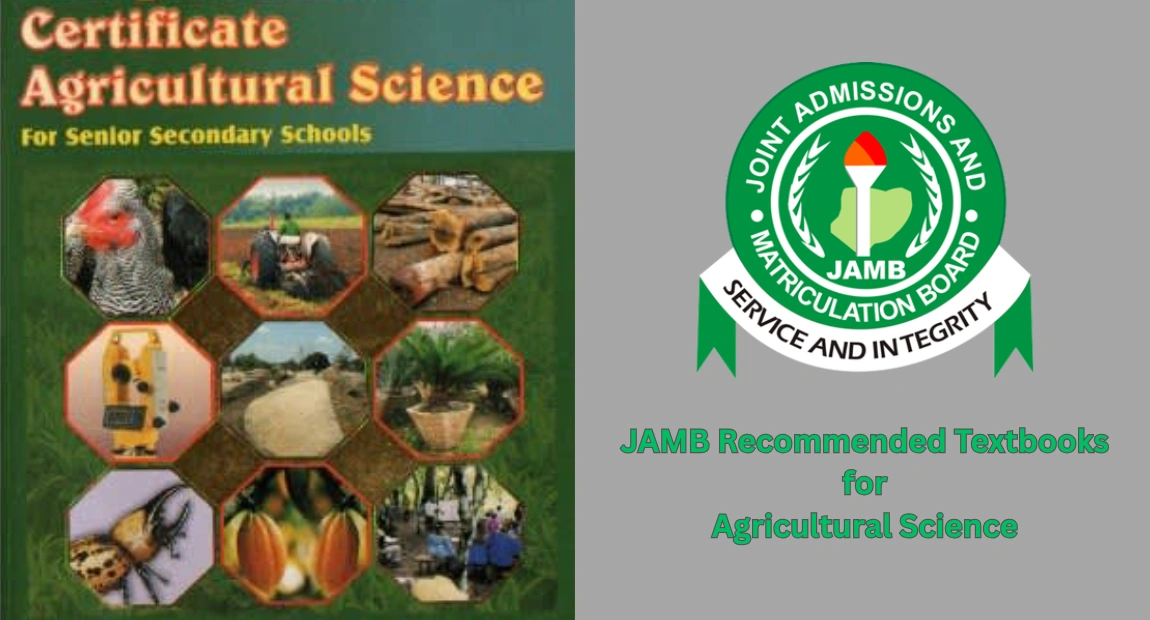
Do you interest in writing Unified Tertiary Matriculation Examination (UTME) for the about to commence academic session with Agriculture as one of your subjects combination? Then, you are lucky to have gotten on this webpage as we have taken our time detailing the JAMB recommended textbooks for Agricultural Science 2026/2027.
These materials are the best Agricultural Science textbooks for UTME as they tend to cover the syllabus comprehensively, and include examples of UTME question patterns. Approved textbooks for JAMB Agriculture are selected because they present Agriculture in simple, practical, and examination-oriented formats suitable for both beginners and advanced learners.
This guide outlines each UTME Agricultural Science study materials, what it covers, and how it helps students prepare effectively for the forthcoming examination.
Recommended Textbooks for JAMB UTME Agric Science 2026/2027
| S/N | Book Title | Author (Year) | Description (Coverage + How It Helps Students) |
|---|---|---|---|
| 1 | Countdown to Senior Secondary Certificate Examination Agricultural Science | Adeniyi, M. O. et al. (1999) | It summarises topics across crops, livestock, soil science, agricultural economics, and common farm practices. It is useful for quick revision, answering CBT-style questions, and strengthening exam readiness. |
| 2 | Junior Secondary Agricultural Science | Akinsanmi, O. (2000) | Although written for junior levels, it provides foundational knowledge that helps students build confidence before advancing to senior secondary Agriculture. Concepts are explained simply, with diagrams and classroom-friendly illustrations. |
| 3 | Senior Secondary Agricultural Science | Akinsanmi, O. (2000) | A widely used Longman text that presents Agriculture systematically. It covers plant and animal production, soil science, pest control, machinery, and agricultural economics. |
| 4 | General Agriculture for West Africa | Anthonio, Q. B. O. (1999) | A classic agricultural text used across West Africa. It explains fundamental principles in a clear, concise manner. Topics include crop production, livestock management, agricultural ecology, soil conservation, and farm management. |
| 5 | Comprehensive Certificate Agricultural Science for Senior Secondary Schools | Are, L. A. et al. (2010) | A modern, detailed, and curriculum-aligned text. It is rich in diagrams, case studies, and topic summaries. It covers all JAMB areas such as crop husbandry, animal science, ecology, soil science, and agricultural economics. |
| 6 | Extension Modern Agricultural Science for Senior Secondary Schools | Egbuna, C. K. et al. (2014) | A recent and updated text that uses simple explanations, practical examples, and illustrations to teach major agricultural topics. It includes numerous objective questions that help students practise for CBT exams. |
| 7 | A Dictionary of Agriculture | Emmanuel C. A. (2003) | A terminology-focused reference guide useful for understanding agricultural terms, definitions, and technical expressions. This dictionary helps students explain difficult concepts, especially in agricultural economics, crop science, and livestock production. |
| 8 | Agricultural Science for Junior Secondary Schools Books 1–3 | Falusi, A. O.; Adeleye, I. O. A. (2000) | These junior school books help students develop foundational understanding of Agriculture. They use simple language, colourful diagrams, and practical examples. |
| 9 | Agricultural Science for Senior Secondary Schools (Books 1–3) | Komolafe, M. F.; Adegbola, A. A.; Are, L. A.; Ashaye, T. I. (2004) | A comprehensive SSCE and UTME-level textbook series. It covers crop and animal science, soil fertility, farm management, agricultural extension, and agro-based industries. |
| 10 | Agricultural Notebook | Philips, T. A. (1986) | A straightforward text that serves as a quick-revision resource. It highlights key agricultural concepts, definitions, diagrams, and summaries. Highly recommended for fast revision before JAMB exams. |
| 11 | Agricultural Science for Senior Secondary Schools | STAN (1999) | Written by the Science Teachers Association of Nigeria, this text follows the national curriculum closely. It explains important agricultural topics clearly, uses structured lessons, and includes exercises designed to build strong analytical skills. |
Recommended Posts:
- Recommended Textbooks for all JAMB Subjects 2026/2027
- JAMB Recommended Textbooks for Biology 2026/2027
- JAMB Recommended Textbooks for Christian Religious Studies 2026/2027
- JAMB Recommended Textbooks for Arabic 2026/2027
How to Study Agricultural Science for JAMB Using These Textbooks
Basically, these books are considered agriculture exam preparation guide and JAMB syllabus Agricultural Science textbooks, and the tips below are meant to help you study effectively:
1. Begin with a comprehensive textbook: Books such as Komolafe et al. or Are et al. provide a strong foundation and match the JAMB syllabus closely.
2. Revise with exam-focused texts: Countdown to SSCE Agricultural Science helps sharpen exam techniques and improve retention.
3. Build understanding: Agricultural Notebook and dictionary-style books help clarify technical terms and improve conceptual understanding.
4. Follow the JAMB syllabus strictly: Agricultural Science is broad; the syllabus helps you focus on what matters for UTME questions.
5. Solve CBT-style practice questions regularly: Agriculture often tests definitions, processes, and applied knowledge, hence regular revision helps you remember details easily.
6. Create summaries and diagrams: Agriculture involves many classifications, cycles, and processes. Visual study aids help you remember faster.
Frequently Asked Questions (FAQs)
Ques: Which Agricultural Science textbook is considered the most reliable for JAMB?
Ans: Comprehensive Certificate Agricultural Science (Are et al.) and Komolafe et al. are among the most recommended.
Ques: Can I use junior school Agriculture textbooks for UTME?
Ans: They are helpful for foundational understanding but should only be used as supplementary materials.
Ques: Is the Dictionary of Agriculture necessary for JAMB?
Ans: Not mandatory, but very helpful for mastering definitions and terminologies.
Ques: Which book is best for quick revision?
Ans: Philips’ Agricultural Notebook and Countdown to SSCE Agric are perfect for fast review.
Ques: Do JAMB questions come directly from these textbooks?
Ans: Not word for word, but the concepts, examples, and definitions originate from them.
Ques: Should I use more than one textbook?
Ans: Yes. A combination of one major text plus a revision text is ideal.
Ques: Are diagrams important in Agricultural Science?
Ans: Yes, diagrams are important in this subject. Many topics such as soil profiles, crop parts, animal anatomy require visual understanding.
Ques: Can I prepare for JAMB Agriculture without practical experience?
Ans: Yes, but practical knowledge helps you understand processes more clearly.
Ques: How many hours per week should I dedicate to Agriculture?
Ans: Two to four sessions per week, with focused revision, is usually enough.
Ques: Are older textbooks like Anthonio still useful?
Ans: Absolutely. Many older books present Agricultural Science concepts more clearly than some newer texts.