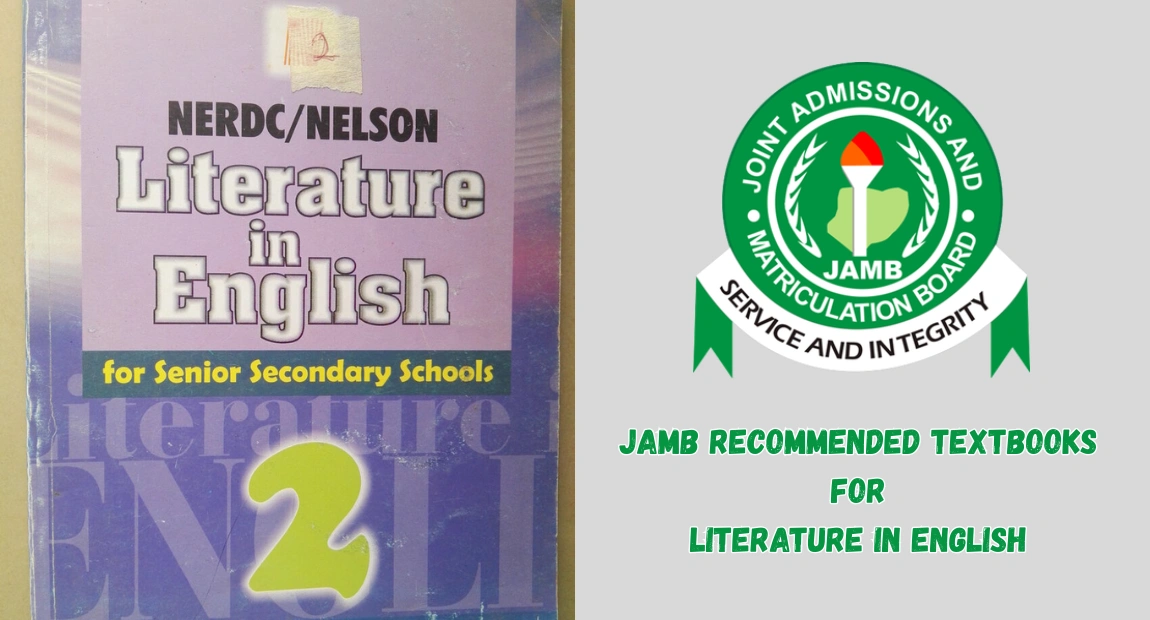
If you’re preparing for JAMB Literature in English 2026/2027, one thing is non-negotiable: you must study the recommended texts. Literature is not a subject you “guess.” JAMB sets questions directly from specific plays, novels, poems, anthologies, and critical texts.
This guide breaks down all JAMB-approved Literature in English textbooks, explains what each book covers, and shows how they help you score high in UTME. Whether you’re aiming for Law, Mass Communication, English, Theatre Arts, or any art-related course, this guide will help you prepare with confidence.
Recommended Textbooks for JAMB UTME Literature In English 2026/2027
Below includes JAMB Literature in English recommended textbooks 2026, JAMB Literature syllabus, Literature set texts for JAMB, JAMB novels plays poems 2026, JAMB literature questions, and literature textbooks for UTME:
A. DRAMA, PROSE & POETRY
| S/N | BOOK TITLE | AUTHOR | DESCRIPTION |
|---|---|---|---|
| 1 | Harvest of Corruption | Frank Ogodo Ogbeche | An African play that explores corruption, greed, morality, and abuse of public office. It helps students understand political drama and character motivation. |
| 2 | Othello | William Shakespeare | A classic tragedy focusing on jealousy, betrayal, manipulation, and race. It sharpens students’ understanding of tragic heroes, conflict, and dramatic irony. |
| 3 | Faceless | Amma Darko | A modern African novel addressing child abuse, street life, gender inequality, and social neglect. Useful for thematic analysis and contemporary prose questions. |
| 4 | Native Son | Richard Wright | A non-African novel dealing with racism, oppression, identity, and social injustice. Helps students analyze character psychology and social context. |
| 5 | Vanity | Birago Diop | A reflective African poem on pride, humility, and mortality. Ideal for poetry interpretation and thematic questions. |
| 6 | Ambush | Gbemisola Adeoti | A poem about danger, uncertainty, and survival. Helps students practice imagery and tone analysis. |
| 7 | Piano and Drums | Gabriel Okara | Explores conflict between African tradition and Western culture. Excellent for symbolism and contrast. |
| 8 | The Dining Table | Gbanabam Hallowell | A powerful poem on violence and war. Helps students understand metaphor and mood. |
| 9 | The Panic of Growing Older | Lenrie Peter | Focuses on aging, fear, and human anxiety. Useful for personal and reflective poetry questions. |
| 10 | The Anvil and the Hammer | Kofi Awoonor | Examines cultural conflict and identity struggle. Important for theme and poetic structure. |
| 11 | Crossing the Bar | Alfred Tennyson | A philosophical poem about death and acceptance. Helps with symbolism and tone interpretation. |
| 12 | The Pulley | George Herbert | A religious poem about human restlessness and divine intention. Useful for understanding metaphysical poetry. |
| 13 | The School Boy | William Blake | A poem criticizing rigid education systems. Helps students analyze social criticism in poetry. |
| 14 | The Proud King | William Morris | Explores pride, power, and humility. Useful for moral and thematic analysis. |
B. ANTHOLOGIES (POETRY & GENERAL LITERATURE)
| S/N | BOOK TITLE | AUTHOR | DESCRIPTION |
|---|---|---|---|
| 15 | Naked Soles | Gbemisola Adeoti (2005) | A poetry collection rich in African imagery and modern themes. Supports unseen poetry practice. |
| 16 | The Penguin Book of English Verse | J. Hayward (1968) | A broad collection of English poems across eras. Helps with poetic devices and styles. |
| 17 | New Poetry from Africa | R. Johnson et al. (1996) | Contemporary African poetry anthology. Useful for African poetry analysis. |
| 18 | Oxford Anthology of English Literature Vol. II | F. Kermode et al. (1964) | Covers major English literary works. Helps with historical context and genre understanding. |
| 19 | West African Verse | Donatus Nwoga (1967) | A collection highlighting West African poetic voices and traditions. |
| 20 | A Selection of African Poetry | Senanu & Vincent (1993) | Focuses on African themes, culture, and politics in poetry. |
| 21 | Poems of Black Africa | Wole Soyinka (1987) | Explores African identity, colonialism, and resistance. Useful for thematic depth. |
C. CRITICAL TEXTS
| S/N | BOOK TITLE | AUTHOR | DESCRIPTION |
|---|---|---|---|
| 22 | A Glossary of Literary Terms | M. H. Abrams (1981) | Explains literary terms like irony, metaphor, tragedy, and imagery. Essential for theory questions. |
| 23 | A Dictionary of Literature | O. E. Emeaba (1982) | Helps students understand literary concepts and definitions tested by JAMB. |
| 24 | Understanding Unseen | M. J. Murphy (1972) | Teaches how to analyze poems and prose not previously read. Extremely useful for unseen passage questions. |
Recommended Posts:
- Recommended Textbooks for all JAMB Subjects 2026/2027
- JAMB Recommended Textbooks for Mathematics 2026/2027
- JAMB Recommended Textbooks for Economics 2026/2027
- JAMB Recommended Textbooks for Computer Studies 2026/2027
Upon reasoning how to study literature in English for JAMB, you are to focus on themes, characters, and setting, memorize key quotes (especially drama and novels), practice poetry analysis daily, use critical texts to understand literary terms, and combine reading with past JAMB questions.
Frequently Asked Questions (FAQs)
Ques: Are these the official JAMB Literature in English textbooks for 2026/2027?
Ans: Yes. These are the approved texts listed in the JAMB syllabus for Literature in English.
Ques: Must I read all the books?
Ans: You don’t need to read them cover-to-cover, but you must understand plots, themes, characters, and poems.
Ques: Does JAMB repeat questions from these books?
Ans: Yes. Many questions are direct or slightly modified from these texts.
Ques: Are poems tested line by line in JAMB?
Ans: Yes. JAMB often asks about imagery, tone, theme, and poetic devices.
Ques: Are critical texts compulsory?
Ans: They are not novels or plays, but they help you answer theory and objective questions correctly.
Ques: Can I use summaries instead of full books?
Ans: Summaries help, but full understanding gives you an edge, especially for tricky questions.
Ques: Is Literature in English compulsory for all students?
Ans: No. It is compulsory mainly for arts and humanities courses.
Ques: Which book is most important?
Ans: All are important, but Shakespeare’s Othello, Faceless, and the poetry section appear very frequently.
Ques: Where can I download these books?
Ans: Most are available in bookshops, libraries, and reputable academic websites.